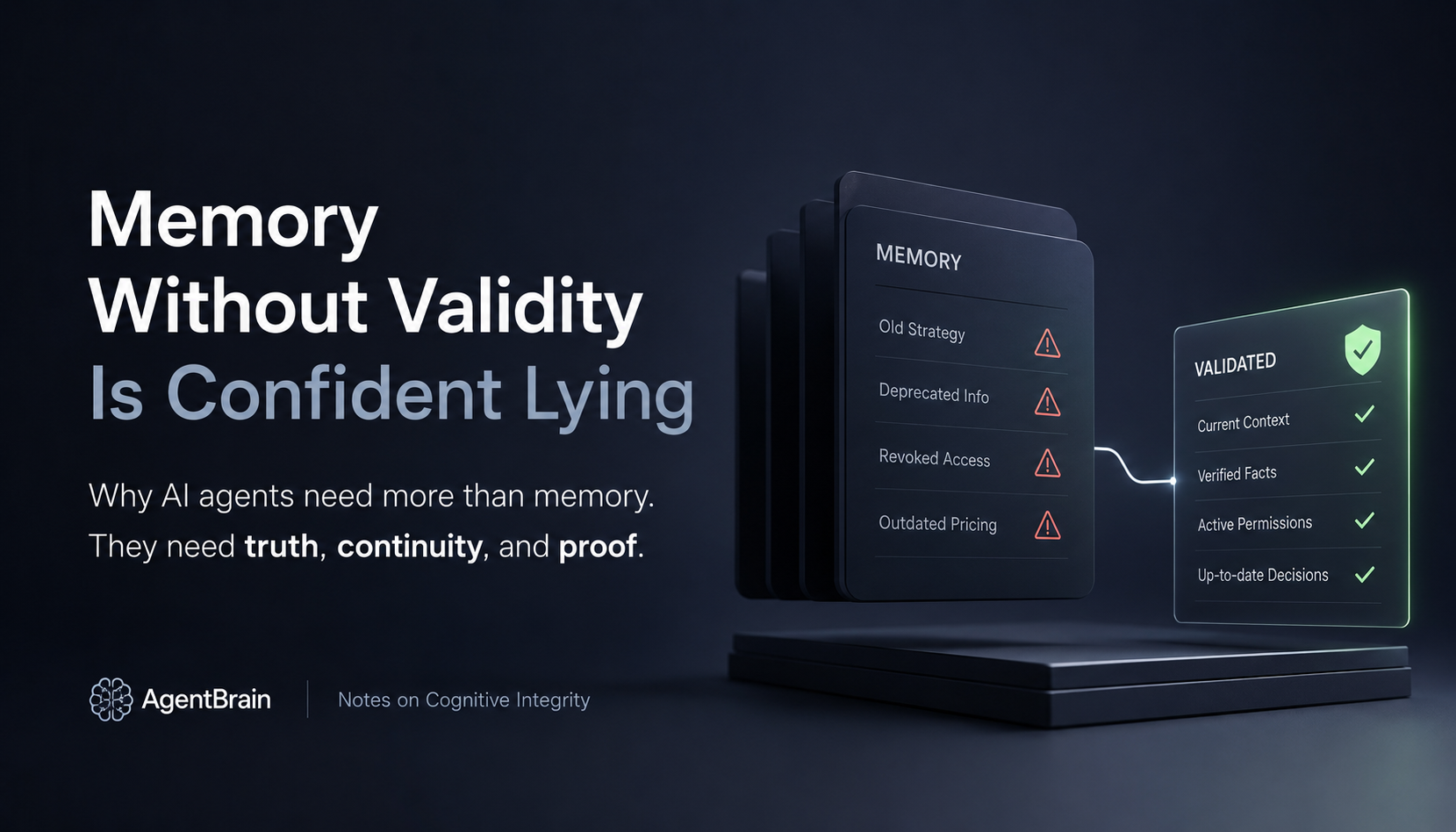
Memory without validity is confident lying.
AI agents don't just need more memory. They need to know what is still true.
For a long time, I believed the biggest problem with AI agents was forgetting.
Anyone who builds deeply with AI knows this specific frustration. You sit down with an agent to build something complex: a strategy, a product roadmap, a pitch, or a software architecture. In the beginning, it feels incredible. The agent understands the context, mirrors your thinking, and feels like a real sparring partner.
Then the session ends.
The next day, you start again. And suddenly, you are back at zero.
You explain the same constraints again. You enter the same priorities again. You correct the same misunderstandings again. The first twenty minutes are spent bringing the agent back to the level it had already reached yesterday.
That feels broken. An agent that has to be manually restarted every day is not a true partner. It is a tool with amnesia.
The first reaction from the industry was obvious: give the agent memory.
More context. Infinite history. Stored decisions. Persistent project notes.
And the first time you use an agent with memory, it genuinely feels like a breakthrough. It remembers your preferences. It recalls a strategic direction you chose last week. It stops asking the same basic onboarding questions. It simply continues.
For a moment, you think: finally. We have moved from chatbot to real agent.
But then comes the second, much more dangerous realization.
The agent remembers something that is no longer true.
- It falls back to an old strategy you explicitly rejected yesterday.
- It builds on an outdated assumption that has already been overwritten.
- It repeats a mistake you corrected three sessions ago.
- It treats historical information as current context.
That is the moment you understand: the real problem is not only that agents forget.
The real problem is that they remember the wrong thing — and deliver it with perfect confidence.
Memory without validity is not intelligence. It is confident lying.
The hidden failure mode
Forgetting is an obvious failure mode. When an agent loses the thread, you notice it immediately. It asks redundant questions, misses the context, or suggests things that make no sense. The human instantly sees that the agent has lost orientation. It is frustrating, but visible.
The validity failure is far more dangerous.
The agent appears to have context. It sounds confident. It retrieves semantically relevant data. The answer is clean, structured, and convincing.
But the underlying truth has expired. It is not fabricated from nothing. It is not a wild hallucination. It is something more dangerous: half-true information that was once correct but is no longer valid today.
In production environments, systems break exactly at this point:
- An outdated customer preference.
- An obsolete product decision.
- An old pricing structure.
- A deprecated API parameter.
- A permission that was revoked yesterday.
If an agent forgets these things, it stops and asks for clarity. But if it remembers them incorrectly, it acts on them. And that is where the risk begins.
Why "more memory" is not enough
When the industry ran into the amnesia problem, the collective answer was purely technical: larger context windows, vector databases, long-term RAG, and stored chat histories.
All of this is necessary. But it only solves Layer 1. It answers only one question: "what is semantically relevant?"
A vector store is very efficient at finding a memory that mathematically matches a user query. A large context window can theoretically hold an entire year of chat history. But a production-ready agent must answer entirely different questions:
- "Is this memory still true?"
- "Was it overwritten by a later human correction?"
- "Is this information stale?"
- "Am I even allowed to perform an action based on this memory?"
- "Can I prove, in an inspectable way, why I relied on this information?"
This is the gap between simple memory and cognitive integrity.
Memory only means that something was stored. Cognitive integrity means the system can verify whether that stored information is still allowed to influence the agent's behavior today.
Why I could not let go of this problem
I did not build AgentBrain because I wanted to create a prettier memory feature. I ran straight into this wall because I was trying to build agents that are genuinely useful over long periods of time.
Not for a quick demo. Not for an impressive screenshot on social media. For real work.
If an agent only answers isolated questions, memory is a luxury. But if an agent is integrated into operational workflows for weeks or months, processes documents, tracks decisions, and interacts with systems, then validity becomes infrastructure.
An agent cannot simply remember "everything." It must understand the hierarchy of time and correction. It must weigh a human correction more strongly than an older data point. It needs the operational maturity to say:
"I remember our previous direction, but it appears to be contradicted by your note from yesterday. I need confirmation before I continue."
That sounds less spectacular than an agent blindly executing a task with one click. But that is exactly where trust begins.
The shift from chatbots to tool-connected agents
As long as AI remains inside a text box, an error is just a bad answer. The human reads it, spots the mistake, types a correction, and moves on. It is inconvenient, but rarely catastrophic.
But agents are evolving. They are no longer just reading prompts. They connect to tools. They access company files, read business inboxes, update databases, write engineering tickets, and trigger webhooks across APIs, browsers, and internal dashboards.
The moment an agent is connected to tools, its memory becomes live infrastructure.
If a tool-connected agent acts on the basis of an invalid, outdated memory, it does not merely generate a bad text response. It creates a system error.
That is why the next critical bottleneck for AI adoption is not raw reasoning power. It is continuity, validity, and governed action.
The model is not the agent
The deeper I went into this problem, the clearer one architectural truth became: the foundation model is not the agent.
Claude can be one runtime surface. GPT can be another. A browser extension, a voice API, an internal dashboard, or an MCP tool can be additional surfaces. The surface will always change depending on the task.
But none of these surfaces should be the sole place where the agent's identity lives.
An agent needs a stable, permanent core. A place where its identity, boundaries, valid memories, human corrections, tool permissions, and historical patterns can live safely. If all of this context is trapped inside a specific prompt or an isolated chat history, the agent effectively resets the moment you change the interface.
That is why we built AgentBrain Core: a governed brain that exists completely separate from models, tools, sessions, and runtime surfaces. The model can change. The tool can change. The governed brain remains.
Validity before recall
The central architectural principle of AgentBrain is simple: validity before recall.
In traditional agent frameworks, memory is treated like a retrieval loop: find the most relevant vector, push it into the prompt, and let the model decide what to do with it.
But relevance is an unsafe metric. A memory can be highly relevant and still be completely outdated, unauthorized, or overwritten.
Before a memory is allowed to influence an agent's behavior, the system must evaluate its state:
current·stale·corrected·uncertain·degraded·blocked
This is not a mystical claim about machine consciousness. It is about an operational state. An agent needs a systematic way to check whether its context can actually be trusted before that context becomes an action.
That is exactly why the Cognitive Dynamics Layer exists. Memory stores what the agent has seen. The Cognitive Dynamics Layer governs what that memory means today.
Memory is not authority
There is a second problem the industry is largely overlooking: when an agent remembers a piece of information, it often behaves as if it automatically has permission to act on it.
But knowledge is not permission.
Knowing how a customer prefers their billing to be structured does not mean the agent is allowed to change a live financial record. Knowing how a workflow operated last month does not mean that workflow is still authorized today.
A governed agent must clearly separate its memory from its operational boundaries.
That is why we developed the Agent Passport. A Passport does not only describe who the agent is. It binds the agent to a governed brain, a specific role, explicit tool scopes, and a real-time trust state: healthy, degraded, or blocked. It ensures that memory never silently turns into unchecked authority.
A useful agent can perform an action. A trustworthy agent can prove that it was allowed to perform it.
Actions need receipts
When an agent acts inside an enterprise system, the explanation can no longer be a black box. The statement "the model produced this decision" is no longer a defensible explanation.
We need Action Receipts.
An Action Receipt is an immutable, inspectable cryptographic proof generated for every critical action. It documents exactly:
- What the agent believed at the moment of execution.
- Which validated memory state influenced that belief.
- Which active permission scope authorized the tool use.
- What exact change occurred after the action.
This shifts agent behavior from unpredictable output to inspectable evidence. Not merely: "the agent executed this webhook." But: "the agent executed this webhook because this specific, validated memory was valid and this active Passport permission allowed the action."
The real test is day ninety
Most AI products are evaluated on day one. How magical is the demo? How fast is the setup? How impressive is the first response?
But for long-running agents, day one is an irrelevant metric. Day one only proves that an agent can sound intelligent in a controlled environment.
The relevant benchmark is day ninety.
- Does the agent make fewer repeated mistakes on day ninety?
- Does it preserve its core mission and boundaries without drifting?
- Does it detect stale assumptions automatically, without human intervention?
- Has it integrated feedback and corrections cleanly over months?
- Has it become demonstrably more reliable without becoming overconfident?
An agent should not only impress you during a discovery call. It should earn your trust across ninety days of real work. That is the benchmark we are building toward.
Toward an Adaptive Cognitive Substrate
The future of agent infrastructure is not simply larger context windows or heavier vector databases. These tools are important, but they remain on Layer 1.
The next decisive category of AI infrastructure will function like an Adaptive Cognitive Substrate: a foundation that enables agents to form, correct, and consolidate long-term patterns without losing identity, validity, or governance.
This is not a claim about consciousness. It is a practical requirement for experience. If an agent is supposed to persist over time, it needs the infrastructure to remember, correct itself, recognize when context decays, and make every single action provable.
This is the line we are building AgentBrain Core around:
- Agents should not reset.
- Memory should not lie.
- Actions should not be unprovable.
If an agent is only built to answer a single question, it does not need us. But if an agent is expected to persist, decide, act, and improve over time, memory alone will fail.
It needs continuity. It needs identity. It needs permissions. It needs cognitive state awareness. And above all, it needs proof.
— Theshoth Sritharan · Founder, AgentBrain · Sachseln, Switzerland · written by a human